East Austin HOME Zoning and Home Values: What’s Changing?
August 13, 2026
August 13, 2026
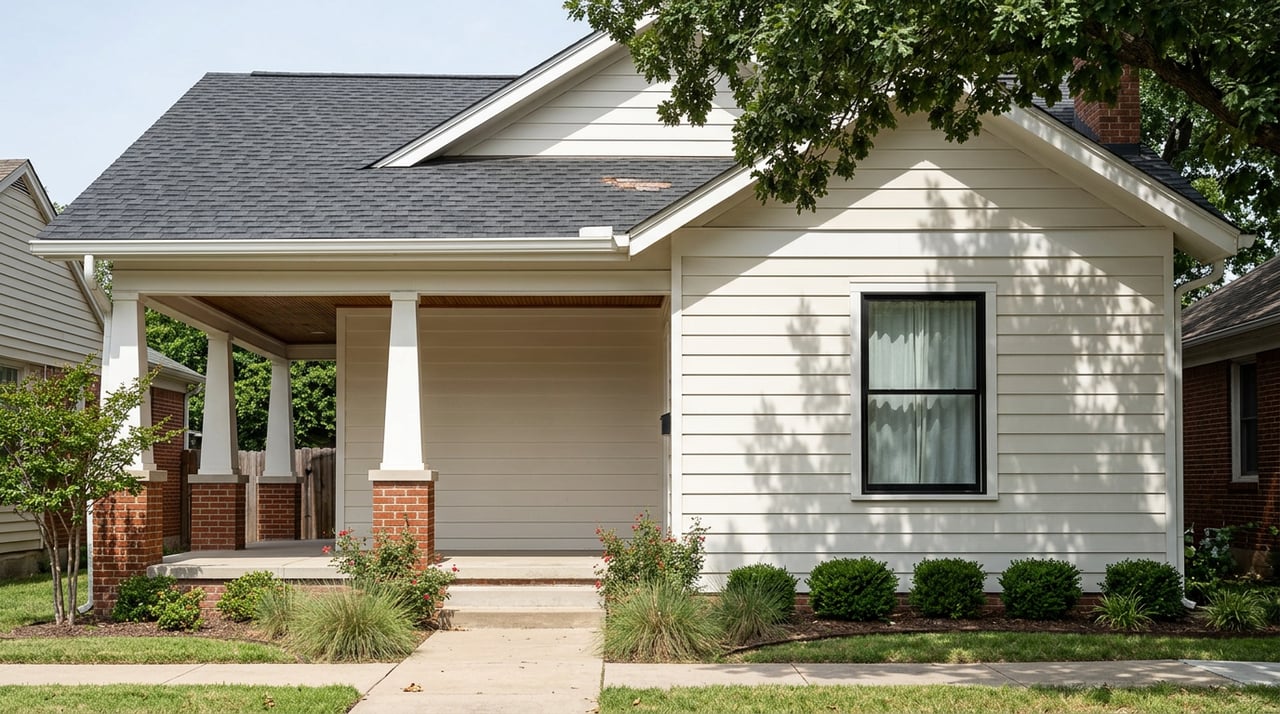
Search "East Austin homes for sale" this week and you will land on two very different kinds of listings on the same page. One is an older single-family bungalow near Chestnut Park, asking well north of $700,000, with a chimney, a shade tree, and a foundation older than most of the buyers looking at it. The other is a brand-new unit in a three-home lot split in Govalle, priced closer to $400,000, sharing a driveway with two other units that did not exist eighteen months ago.
Both show up under the same neighborhood label. Both get folded into the same median. And that median has been falling.
Over the three months ending May 2026, the median sale price in East Austin was $540,000, down 9.27% from the same period the year before, with homes taking an average of 56 days to sell compared to 50 the year prior. Zoom out to the Austin metro as a whole and the story reads differently: as of June 2026, the metro-wide median sale price was $450,000, up 1.1% year over year. One number is falling. The other is rising. Same city, same window, opposite direction.
That divergence is not a coincidence and it is not East Austin cooling off while the rest of the metro holds steady. It is a composition problem, and understanding it is the difference between reading the market correctly and misreading it in either direction.
Since Austin's HOME initiative took effect, a growing share of what sells in East Austin is not a single-family home at all. It is one unit of a two- or three-unit lot split, priced to move fast and priced well below what a traditional single-family purchase costs.
The Austin Board of Realtors put numbers on this gap in its 2025 analysis, reported by Community Impact: of 57 HOME-built units sold that year, the median sale price came in at $750,000, against a median of $1.58 million for 115 non-HOME single-family homes sold in the same period. That is not a small spread. It is close to double.
When a market blends a rising volume of $750,000 product with a flat-to-rising base of $1.58 million product, the blended median moves toward the cheaper, more numerous category even if neither category is actually losing value on its own. That is the mechanical reason East Austin's median can drop nine percent while the neighborhoods inside it are not necessarily getting cheaper to buy into. The mix changed. The prices underneath it may not have.
Austin's HOME initiative rolled out in two phases. Phase 1 passed in December 2023 and took applications starting in February 2024, allowing up to three housing units on most single-family lots. Phase 2 followed in May 2024, with applications accepted starting that August, and cut the minimum lot size dramatically, from 5,750 square feet down to 1,800 square feet in many cases, according to an analysis from the Texas Public Policy Foundation. That single change is why a standard East Austin lot that used to support one house now routinely supports two or three.
The building numbers back this up. In the year before HOME-1 took effect, builders in Austin's single-family zones filed permits that resulted in 487 certificates of occupancy. In the year after, that number jumped to 906, an 86% increase, per the same Texas Public Policy Foundation review. East Austin, with fewer historic overlay protections and fewer HOA restrictions than the city's western neighborhoods, absorbed a large share of that new activity. That is the supply side of the split median. More lots are producing more, smaller units, and each one sells for meaningfully less than the single-family home it might have replaced.
The compositional effect is not evenly spread across East Austin. Some pockets are seeing heavy lot-split activity. Others are largely untouched, and the traditional single-family market there is behaving the way traditional single-family markets behave.
| Neighborhood | What's mostly selling right now | Where it tends to land |
|---|---|---|
| Holly | Established single-family stock near Lady Bird Lake | Median home values near $884,500 |
| Mueller | Planned-community single-family and townhome product | Average sale price near $929,000 |
| Cherrywood | Mostly intact single-family bungalow stock | Median near $659,500 |
| Chestnut | A mix of renovated bungalows and new infill | A wide range, roughly $450,000 to $850,000 depending on the block |
| Govalle | Heavy lot-split and new-construction activity alongside older single-family homes | Entry points below $500,000 for smaller or split-lot product, while single-family houses carried a median near $744,450 as of June 2026 |
| Windsor Park | Entry-level single-family stock, some infill activity | Entry points below $500,000, among the most affordable in the area |
Notice that Govalle's own numbers do not agree with each other, and that is the point. Entry-level product sits under $500,000 while single-family houses in the same neighborhood carried a median near $744,450 as of June 2026. That is the compositional effect showing up at the block level, not just the East Austin level. If you are shopping Govalle and only look at one number, you have no idea whether you are pricing a lot-split unit or a full single-family lot until you check what is actually on the parcel.
The reason this matters beyond arithmetic is that East Austin sits inside what planners and researchers call the Eastern Crescent, a term that comes out of the University of Texas's Uprooted research on displacement risk. The Uprooted project describes this area as a backward C-shape running from north of downtown southeast and then south, historically lower-cost neighborhoods now facing rising demand from higher-income buyers.
That framing is not academic trivia. It is the backdrop for a live policy fight, and it has been for a while. Back in spring 2024, ahead of HOME Phase 2's passage, community groups including Community Powered ATX and Go Austin/Vamos Austin pushed for an equity and anti-displacement overlay, arguing that the ability to build three homes where one stood before would draw speculators into neighborhoods where longtime residents were already at risk of being priced out. More than two years later, the argument is still unresolved. In May 2026, City Council took up a resolution from Council Member Krista Laine to study extending HOME allowances into additional protected districts, a move Council Member Marc Duchen pushed back on, citing cases where the policy produced pricier replacement housing rather than more affordable options, according to Community Impact's coverage of the vote.
Not every project in East Austin fits the speculation narrative. Mira, a 12-unit townhome development that broke ground in 2025 on Springdale Road in Govalle, includes two homes reserved for households earning at or below 65% of median family income, built through a partnership between developer Aus/Bos Social Housing and the Austin Housing Finance Corporation. It is a useful reminder that the same zoning tool producing $750,000 spec units elsewhere is also producing income-restricted product in specific projects. The label "HOME-built" does not tell you the price point on its own. You still have to look at the individual listing.
Before you anchor to any number you see attached to an East Austin address, work through this:
Does East Austin's falling median mean it's a better time to buy a traditional single-family home there? Not automatically. The median is falling because more lower-priced HOME-built units are entering the sales mix, not because traditional single-family homes in neighborhoods like Holly, Mueller, or Cherrywood are necessarily getting cheaper. Price a specific home against comps in its own category, not against the blended neighborhood median.
How do I know if a listing is a HOME-built unit before I tour it? Look at the lot size and the listing history. A lot under roughly 5,750 square feet that shows recent construction, or a listing that references sister units on the same parcel, is a strong signal. Your agent can also pull the plat and permit history directly.
Is this compositional effect happening in other parts of Austin, or just the east side? HOME applies citywide, but East Austin has absorbed a disproportionate share of the activity because it has fewer historic overlay protections and fewer restrictive HOAs than neighborhoods west of I-35. Other lower-overlay neighborhoods could see a similar median effect over time, but as of summer 2026 the volume is concentrated on the east side.
Numbers like a falling median tell you something happened. They do not tell you what happened, and in a market where two very different products share a zip code, that gap is exactly where buyers get it wrong in either direction. If you are trying to figure out what a specific East Austin block is actually doing, not what the blended average says it's doing, Kaili Cox works this corridor block by block and can walk you through the comps that actually apply to the home you're looking at. Request a free home valuation to start with a number that reflects your property, not the average of two different markets.
Stay up to date on the latest real estate trends.

Get assistance in determining current property value, crafting a competitive offer, writing and negotiating a contract, and much more. Let me guide you through your home-buying journey.
Pine Tree Realty Group
10222 Pecan Park Blvd Ste. 10 Austin, TX 78729