How To Evaluate A Wooded Homesite In Bastrop
May 14, 2026
May 14, 2026
Choosing a wooded homesite in Bastrop can feel exciting right up until the practical questions show up. Can you actually build where you want, keep the trees you love, and avoid expensive surprises with access, septic, or floodplain rules? If you are thinking about buying land for a custom home or future build, this guide will help you evaluate the lot more clearly before you spend heavily on plans, clearing, or improvements. Let’s dive in.
A wooded lot is not just about how it looks from the road. In Bastrop, the way the land sits, where the trees are clustered, and how water moves across the site can affect where your home, driveway, and outdoor areas make the most sense.
Window orientation matters when you plan a home site. U.S. Department of Energy guidance notes that south-facing openings can capture more winter sun, while east- and west-facing glass can bring in more unwanted heat. On a wooded Bastrop lot, that often means you want to balance tree retention with enough usable sun exposure for comfort, light, and design flexibility.
Trees can also affect more than curb appeal. If your lot is inside Bastrop city limits, removing trees may trigger a mitigation permit under the city’s Tree Mitigation Ordinance. That means mature trees may add value and character, but clearing them may not be as simple as choosing where you want open space.
Drainage should be part of your first walkthrough, not an afterthought. The City of Bastrop notes that drainage plans or site development review may be required depending on the project. If you plan to clear land for a house pad, driveway, or other improvements, you want to understand how runoff and grading could shape the build envelope.
A wooded tract can look perfect in person and still create problems if the legal lot status is unclear. Before you fall in love with the setting, make sure the property is legally described, recognized correctly, and actually buildable under the applicable rules.
Bastrop County’s GIS portal and Bastrop CAD are helpful research tools, but they are not a substitute for a survey. The county states that its maps are approximate and not suitable for legal, engineering, or surveying purposes, and BCAD says legal descriptions and acreage amounts should be verified before being used for legal documents. In plain terms, online maps are a starting point, not final proof.
Jurisdiction matters too. Bastrop County states that land division is regulated by state law and county subdivision rules, but incorporated cities handle subdivision regulation within city limits. If you are looking at a lot in or near the City of Bastrop, you want to confirm which rules apply before assuming the parcel is ready for a home build.
If the tract needs 911 addressing, the City of Bastrop’s GIS and Development Services process asks for a BCAD property ID, legal description, and site layout. That is another reason to verify the parcel details early. A vacant lot does not always come with every piece of build-ready information already in place.
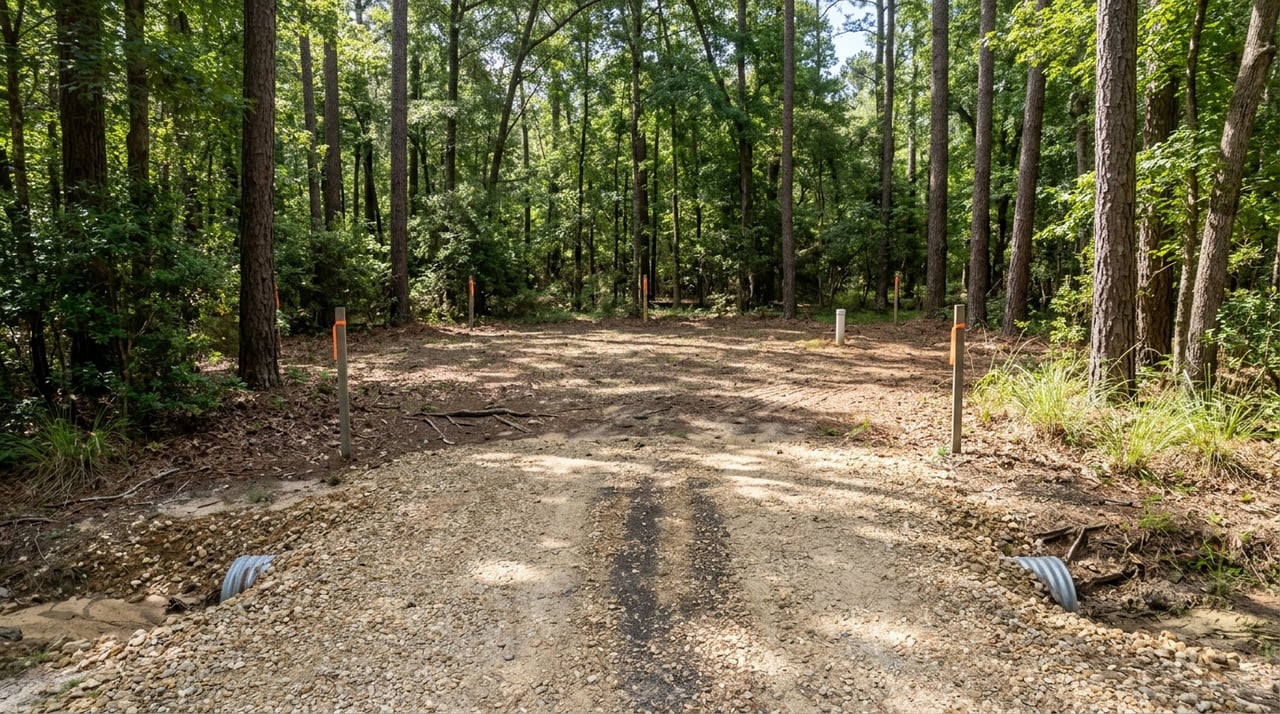
Access can be one of the biggest issues on wooded land. A lot may appear easy to reach, but legal and physical access are not always the same thing.
Bastrop County requires permits for driveways, sidewalks, culverts, and similar work within county rights-of-way. The county also states that shared access driveways require a recorded joint use access agreement. If the driveway connects to a state right-of-way, it must be permitted through TxDOT.
This matters because a beautiful build site deep on the lot does not help much if driveway approval, culvert installation, or shared access rights become difficult or costly. On wooded parcels, where mature trees and topography may narrow your options, driveway placement should be part of your evaluation from day one.
One of the most common mistakes land buyers make is assuming utilities will be simple. In Bastrop, that answer depends on where the lot is located and whether public service is available.
Inside city limits, the City of Bastrop Utilities handles water, electric, and sewer emergencies and account setup. On rural parcels, you should confirm who provides each utility before you commit to a site plan. Water, electricity, and wastewater may each involve different providers depending on the property.
If public wastewater is not available, septic planning becomes a major part of due diligence. Bastrop County says the development permit and OSSF permit should be submitted concurrently. The county also says the septic application requires a site evaluation report from a licensed site evaluator or professional engineer, and the proposed system must meet setback requirements from property lines, wells, buildings, easements, and bodies of water.
That means a wooded lot is not truly ready for your dream floor plan until you know where the septic system can go and how that placement affects the house, driveway, and outdoor improvements. Septic feasibility often shapes the real build envelope more than buyers expect.
Floodplain review is not optional in Bastrop. It is one of the most important steps when evaluating any vacant lot, especially one with tree cover, changing elevation, or proximity to drainage paths.
Bastrop County says a development permit is required for all development in unincorporated areas. If the property is in the floodplain, the owner must hire a surveyor to certify that construction meets county floodplain rules. The City of Bastrop also requires a floodplain development permit before other permits when a property is in the floodplain, and the city uses FEMA flood studies and FIRMs in its floodplain administration.
For you as a buyer, this means floodplain status should be checked before you finalize your budget or house plans. A wooded lot may feel private and peaceful, but floodplain constraints can change where and how you build.
Wooded homesites in Bastrop often come with one more layer of review that buyers overlook. Depending on where the tract is located, tree protection rules or habitat-related requirements may affect what you can clear and when.
Inside the City of Bastrop, tree removal can trigger a mitigation permit. That can influence lot design, clearing costs, and even how much flexibility you have for the final house position.
Bastrop County’s Lost Pines Habitat Conservation Plan covers about 124,000 acres of known and potential Houston toad habitat. The county says development-related activities can include vegetation clearing, road construction, and utility installation. If your parcel falls within the plan area, it is smart to ask early whether a construction certificate or other step applies before clearing or building.
This is especially important on wooded tracts because the very features that make the property attractive, like dense tree cover and a natural setting, may also be the features that require more review.
In Bastrop, evaluating a wooded lot also means thinking about wildfire readiness. This is not just about insurance or future maintenance. It is also about how practical and safe the homesite will be once it is built.
Bastrop County ESD No. 1 provides fire education, fire safety inspections, suppression, and all-hazards response and mitigation. Texas A&M’s Texas Fire Danger system rates fire danger using fuels, weather, and topography. On wooded sites, access, turnaround space, and fuel management should be part of your overall planning.
When you walk a lot, consider whether emergency vehicles could reasonably access the home site and whether the property offers room to manage vegetation around future improvements. A heavily wooded setting can be beautiful, but it should also be workable.
The best wooded-lot purchases usually happen when the right people are involved early. In Bastrop, that often includes a surveyor, a licensed site evaluator or professional engineer for septic questions, and a builder who understands local permitting.
If tree removal may be part of the project inside city limits, it also helps to work with someone who understands Bastrop’s tree rules. Bastrop County and the City of Bastrop both offer development and permitting pathways that are meant to be checked before design work gets too far along.
It is also important to verify private restrictions. County staff state that they do not interpret deed or property restrictions, so you still need to confirm easements, HOA rules, and private deed restrictions on your own. On wooded tracts, those private limits can affect access, clearing, and where a home can realistically sit.
Bastrop County’s Planning and Platting Department also offers free pre-development meetings for plat applicants. Those meetings can help clarify whether a tract is a legally buildable lot, whether a platting exemption may be needed, and what issues could appear later.
When you are excited about a beautiful wooded lot, it is easy to jump straight to house plans. In most cases, the better move is to work through the lot fundamentals first.
A smart sequence in Bastrop looks like this:
That order can help you avoid spending money on plans for a part of the lot that may not work.
If you are comparing wooded homesites in Bastrop, having local guidance can make the process much clearer. Kaili Cox helps buyers evaluate land, lifestyle lots, and build potential across Bastrop County with a practical, client-first approach.
Stay up to date on the latest real estate trends.


Get assistance in determining current property value, crafting a competitive offer, writing and negotiating a contract, and much more. Let me guide you through your home-buying journey.

Pine Tree Realty Group
10222 Pecan Park Blvd Ste. 10 Austin, TX 78729